
AI agents (Amazon Rufus, Walmart Sparky, Carrefour Hopla+) are no longer experiments. In 2026 they have become distribution channels in their own right. And most food brands don't know it yet.
This is not a trend to watch. It is a rule change already under way. Brands that wait for the topic to go mainstream before reacting will land in an already consolidated market, 18 to 24 months behind.
The numbers no one discusses publicly.
In France, Carrefour launched Hopla+, its AI assistant, directly inside the ChatGPT interface on 27 March 2026. 26 million French users can now order without leaving the conversation. The most-ordered categories: dairy, bakery, dry grocery.
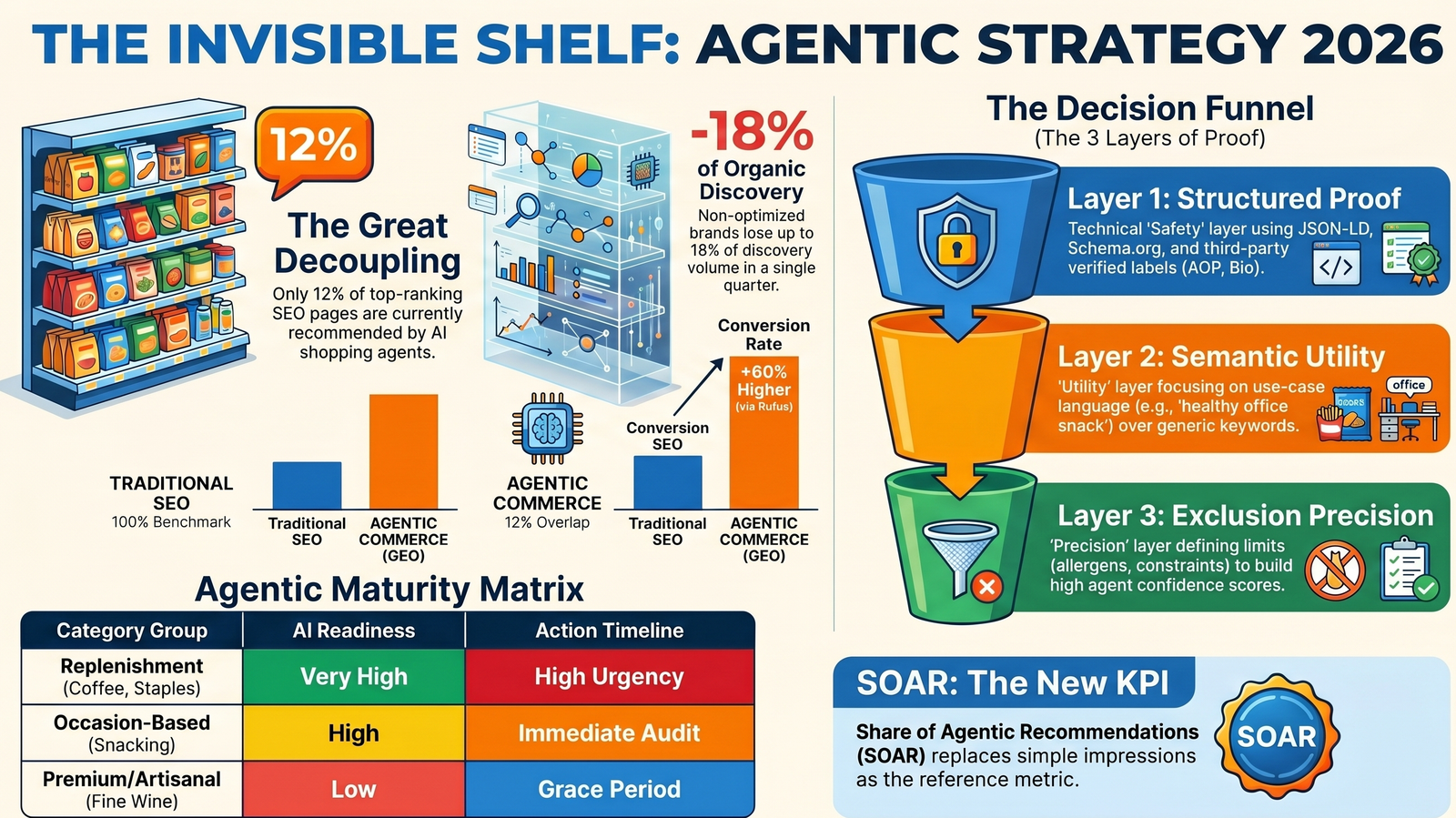
And the most worrying signal: only 12% of products that rank well in traditional SEO appear in AI-agent recommendations. Being number one on Google no longer guarantees anything on Rufus or Hopla+.
How agents decide: three layers of data.
AI agents do not browse. They extract, verify, recommend. For a product to be recommended, it must satisfy three layers of data, in this order.
Verification
Agents favor data verified by third parties. Organic, PDO, fair-trade and quality-label certifications must be structured in JSON-LD or schema.org to be machine-readable.
A "premium quality" claim in marketing copy does not count. A certification the agent's knowledge graph can verify does.
Semantic context
Agents look for usage data, not keywords. A product described as "ideal for the breakfast of busy parents" will be recommended more often than one simply labeled "oat flakes".
Rufus's COSMO engine parses usage contexts, target audiences and consumption environments.
The logic of constraint
Agents reward brands that define their limits. "Not suitable for people with nut allergies": statements like this build a trust score.
By excluding the wrong use cases, a brand increases its chances of being recommended to the right profiles.
The coffee case illustrates this gap exactly: the challenger had structured its fair-trade certifications in JSON-LD, documented its origin coordinates and made its carbon footprint verifiable. The agent could confirm every claim. For the premium brand, it had to "assume". It chose certainty.
The polarization of categories.
The impact of agentic commerce is not uniform. Four groups of categories by readiness level:
| Category | Agent readiness | Urgency | Examples |
|---|---|---|---|
| Replenishment | Very high | Now | Dry grocery, coffee, household |
| Occasion | High | Q3 2026 | Snacking, seasonal products |
| Fresh / perishable | Medium | 2027 | Meat, fresh produce |
| Premium / artisanal | Low | Delay, not immunity | Fine wines, PDO cheeses |
Category leaders that failed to optimize their data lost between 12% and 18% of their organic discovery volume in a single quarter. That share was captured by challengers more agile with their data.
The paradox of silence.
It is the most telling signal of the market's state in 2026: the practitioners who have already optimized their data for AI agents do not brag about it. Closed forums, earnings calls, vendor partnerships: that is where it happens. Not on LinkedIn, not in interviews.
Mars United developed a new metric: SOAR, Share of Agentic Recommendations. Brands that adopted the right optimization protocols saw their mentions in Rufus multiply by five. They made no public announcement of it.Mars United, Decoding Rufus, 2026
The consequence is direct: brands that wait for the topic to be "mainstream" before reacting will end up optimizing their data in an already consolidated market. The first-mover window is open. It will not stay open for long.
The 2026 agent-ready checklist.
For an agent to recommend your product, each of the following must be in place.
A realistic timeline.
The strategic question.
Food marketing long ran on a simple equation: great packaging, good search ranking, shelf presence. That equation is not dead. But it is incomplete.
There is now a third shelf: invisible, operated by AI agents, growing at a speed the European market is only beginning to measure. The brands visible there will not necessarily be the best known or the best funded. They will be the ones whose data is richest, most structured and most verifiable.
The question is no longer "how do I get found by a consumer". It is "how do I get understood by an agent buying on their behalf".Audrey Le Borgne, MaïMaï Consulting, May 2026
Sources.
MaïMaï Consulting market watch, May 2026. Sources published between January and May 2026.
Amazon Rufus · Agentic Commerce
- Mars United, Decoding Rufus: Factors Driving Agentic Search Recommendations, 2026
- PPC Land, Amazon's AI shopping assistant drove $12 billion in sales for 2025
- Velocity Sellers, Amazon Rufus AI in 2026: How Shopper Behavior Is Changing, April 2026
Carrefour Hopla+ · France
- PPC Land, Carrefour bets on AI, ChatGPT, and smart shelves, March 2026
- Capgemini, Reimagining customer experience: Human-led, AI-powered, April 2026
SEO / GEO · Market data
- Lily Ray / SEO S7, The Agentic Web: How AI Agents Decide Which Brands Make the Cut, 2026
- Bloomreach, What Is Agentic Commerce?, 2026
- Simpactful, What Walmart's Acceleration Means for CPG Brands, 2026
- Velocity Sellers / Bloomreach, organic discovery loss, Q1 2026
Protocols and standards
- McKinsey, The Agentic Commerce Opportunity, 2026
- Gemini Deep Research, The Agentic Revolution in FMCG, May 2026